Søndag skrev jeg en lengre analyse av krigen, mens jeg i dag skal nøye meg med å lenke og sitere fra interessante artikler publisert etter min artikkel. Noen av disse vil være åpne, andre for abonnenter, men i det siste tilfellet er det ofte mulig å få tilgang ved å registrere seg.
Jeg viste i går til den første meningsmålingen etter angrepet, fra YouGov, der 44 prosent av amerikanerne var imot angrepet, og 34 prosent for. Den var tatt opp lørdag. Samme dag og søndag foretok Ipsos sin måling, som viser litt mer negative tall – 43 prosent imot og 27 prosent for. Men i begge er det altså mange usikre, som nok vil la seg påvirke av hvordan krigen faktisk utvikler seg.
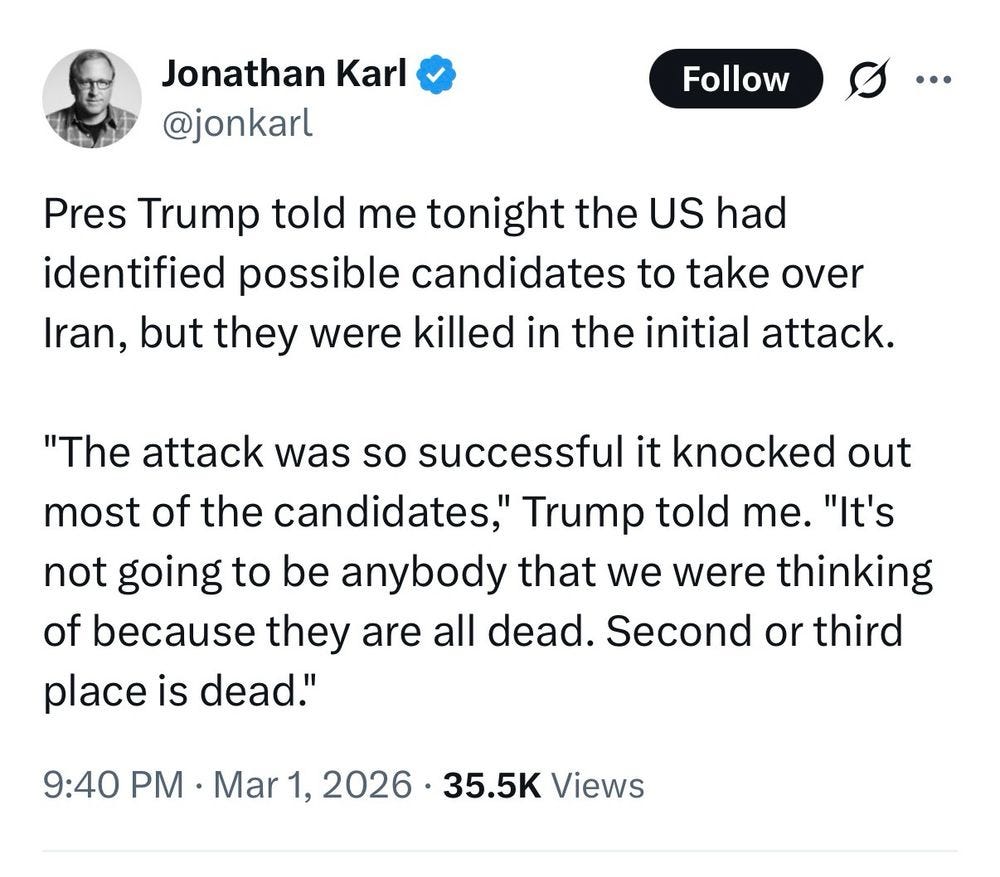
Et tema jeg skrev om var hvorvidt Trump ville ha regimeskifte, eller bare noen endringer i regimet. Til New York Times uttalte han seg søndag i retning det siste:
“What we did in Venezuela, I think, is the perfect, the perfect scenario,” Mr. Trump said. (…) “Everybody’s kept their job except for two people.”
War of choice
Jeg konkluderte med at dette var en «war of choice», og David Sanger underbygger dette i New York Times:
«He was not driven by an immediate threat. There was no race for a bomb. Iran is further from the capability to build a nuclear weapon today than it has been in several years, thanks largely to the success of the president’s previous strike on Iranian nuclear enrichment sites, in June.
While Mr. Trump claimed Tehran was ultimately aiming to reach to the United States with its array of missiles, even his own Defense Intelligence Agency concluded last year that it would be a decade before Iran could get past the technological and production hurdles to produce a significant arsenal.
And there were no indications of a coming Iranian attack on the United States, its allies or its bases in the region.»
Etterretning styrte timingen
New York Times skriver om hvordan amerikansk og israelsk etterretning samlet informasjon som gjorde det mulig å slå ut store deler av det iranske lederskapet på samme dag. Dette var også avgjørende for tidspunktet angrepet kom på.
«The C.I.A. had been tracking Ayatollah Khamenei for months, gaining more confidence about his locations and his patterns, according to people familiar with the operation. Then the agency learned that a meeting of top Iranian officials would take place on Saturday morning at a leadership compound in the heart of Tehran. Most critically, the C.I.A. learned that the supreme leader would be at the site.
The United States and Israel decided to adjust the timing of their attack, in part to take advantage of the new intelligence, according to officials with knowledge of the decisions.»
Revolusjonsgardens rolle
Wall Street Journal har publisert en lengre analyse av en svært sentral aktør i denne krigen, den iranske revolusjonsgarden.
“The Islamic Revolutionary Guard Corps is best known as an armed force of nearly 200,000 paramilitary members. It also functions as a parallel government and economic force whose main mission is defending the Islamic regime formed after the 1979 Revolution and spreading its influence throughout the Middle East.
Unless the IRGC is defeated or somehow turned, it will retain its ability to generate cash through illicit activities and help proxies like Houthi militants in Yemen harass the U.S. and its allies. The IRGC has its own military and intelligence divisions separate from the conventional armed forces and is deeply entrenched in the country’s businesses. (…)
The IRGC is a dominant force inside Iran, but in a matchup with the U.S. and Israel, it is hopelessly outgunned. Still, crippling the organization could take weeks or even months of additional airstrikes and other military steps, analysts and Iranian opposition leaders said. Without doing so, the Iranian regime is likely to remain in place and become even more repressive as hard-liners who survived the initial U.S. and Israeli strikes further unleash the IRGC’s armed loyalists in hopes of clinging to power.”
Ali Vaez understreker i Foreign Affairs den store usikkerheten omkring hva som skjer fremover, og avrunder sin artikkel med hvor viktig revolusjonsgarden er:
“Still, if the U.S. bet is that airstrikes will finish the job from above while Iranians complete it from below, that bet rests on no clear historical model and ignores the resilience of entrenched authoritarian systems under external pressure. Other scenarios seem easier to imagine: for example, more overt control by a Revolutionary Guard that has already become a preeminent political and economic actor under Khamenei, or prolonged civil strife between those seeking to topple the system’s remnants against those clawing to preserve it.”
Hvem går tom?
Både Iran og USA har godt med ammunisjon, men lagrene er ikke ubegrensede. Det handler i stor grad om balansen mellom å kunne fyre av raketter og sende droner, og kapasiteten til å skyte dem ned. Gerry Doyle skriver hos Bloomberg:
«Dozens or more Iranian missiles were intercepted on Saturday around the region, but at least a few got through. The result of continued strikes is that if Iran has more missiles than its targets have interceptors, more attacks will start getting through. Magazine capacity was already low” for the US and its partner nations after last year, said William Alberque, a senior adjunct fellow at the Pacific Forum, a foreign policy research institute.”
Wall Street Journal peker på samme problem:
“The precise size of the U.S. stock of air-defense interceptors—what the Pentagon calls magazine depth—is classified. But repeated conflicts with Iran and its proxies in the Middle East have been eating into the supply of air defenses in the region.
Since Saturday morning Tehran time, the U.S. and its allies in the region have pounded an array of leadership and military targets in the country, including Iran’s missile launchers, drones and airfields. One reason the U.S. and Israel struck first, a senior official said Saturday, was to blunt Iran’s ability to retaliate with its missiles and drones.”
Sjahen
Den tidligere sjahens sønn Reza Pahlavi skriver i Washington Post under en tittel som minner om smiskingen til den venezuelanske opposisjonslederen Maria Corina Machado: “Thanks to President Trump, the hour of Iran’s freedom is at hand.” Han viser til at hans gruppe allerede har utarbeidet en plan for en overgang til demokrati – Iran Prosperity Project. Den omfatter en overgangsregjering, ledet av ham selv. “Our path forward will be transparent: a new constitution drafted and ratified by referendum, followed by free elections under international oversight. When Iranians vote, the transitional government dissolves.»
Politico skriver om hans plan under denne ingressen: «His pitch to the White House? MIGA: Make Iran Great Again. And there’s money to be made with Pahlavi as a partner.” Men de viser også til kritikere:
“But Johns Hopkins Professor Vali Nasr told ABC’s “This Week” on Sunday that he is skeptical Pahlavi actually has the bandwidth to pull off a stable leadership transition.
“Right now, he does not have a ground game in Iran, if you were to say,” Nasr said. “There’s no political organization alliances, he has not built a relationship with with bureaucrats, with politicians, etc, that actually would allow him to play a critical role at this moment in time and to have a plan for the day after essentially being able to take over the government.”
Hormuz-sjokk
Economist skriver om Irans forsøk på å stenge Hormuz-stredet:
“Hormuz has never been closed to maritime traffic, even during the Iran-Iraq war in the 1980s. Choking it off would antagonise China, which buys nearly all of Iran’s oil and receives 37% of its seaborne crude imports through the Strait. Iran seems intent on cutting off the strait anyway. “
Sarah Shiffling hos The Conversation er opptatt av samme tema:
«Although the shipping lanes are only about two miles wide, actually physically closing them would be difficult to achieve. The most decisive action Tehran could take would be to mine the shipping lanes. With the large US naval presence in the area, this would be very difficult for Iran to achieve.
But a formal blockade is not necessary to stop traffic. When perceived threat levels rise, ships stay away. Big shipping companies such as Hapag Lloyd and CMA CGA have already suspended transit through the strait and advised their ships to proceed to shelter.»
Israel fornøyd med kaos
Politico skriver om Israels mål for krigen. Et vennligsinnet regime i Tehran vil selvsagt være gunstig, men det er ikke nødvendig. Det viktigste er at Iran er svakt.
«Netanyahu thinks he comes out on top, even if the popular uprising he is calling for plunges the nation into violent disorder. In an ideal world, a friendly regime appears in Tehran. But Israel often makes the Realpolitik judgment that turmoil can bolster its interests too.
That has been obvious in Lebanon and in Syria. Netanyahu has not assisted the Lebanese authorities in their efforts to discipline Hezbollah’s Shiite militia, or to get them to disarm. He has done quite the reverse, continuing air raids and drone strikes. Similarly, he’s stirred up trouble for the new leadership in Damascus by backing the Druze minority. In the Palestinian territories, Netanyahu is often accused of exploiting the divisions between Hamas and the Palestinian Authority.
The logic is clear. If countries are consumed by internal political strife — even civil war — they can’t get their acts together and turn on Israel.”
Lovlig uten kongressen?
Relativt Trump-vennlige Jeb Rubenstein skriver hos The Free Press om Trumps krig uten kongressvedtak er ulovlig. Han går gjennom amerikansk historie og alle presidenter som faktisk har gjort nettopp det, og konkluderer med at grensen går ved langvarig bakkekrig:
“It is pointless today to claim that U.S. presidents lack the power to engage in major military attacks on foreign countries without congressional approval. They clearly exercise that power, and the courts do not intervene. As Justice Oliver Wendell Holmes put it long ago, law is largely a prediction of what courts will do, and from that point of view, there is no law against what Trump is doing.
But at the end of the day, there does have to be a redline—a line beyond which courts must intervene. As some OLC opinions have stated, that line is crossed when a president sends a major deployment of U.S. troops into a foreign country to fight that country’s army for a sustained period of time. That has to be the making of war, for constitutional purposes.”
Den konservative kommentatoren David French er uenig, og skriver i New York Times.
“Trump should have gotten congressional approval for striking Iran, or he should not have struck at all. And because he did not obtain congressional approval, he’s diminishing America’s chances for ultimate success and increasing the chances that we make the same mistakes we — and other powerful nations — have made before. (…)
But the constitutional structure, when followed, does much more than that. It also helps provide accountability. To make the case to Congress, a president doesn’t just outline the reasons for war; he also outlines the objectives of the conflict. This provides an opportunity to investigate the weaknesses of the case for the conflict, along with the possibility of success and the risks of failure.”
Ukraina-koblinger
Bohdan Nahaylo, redaktøren for Kyiv Post, skriver om mulige virkninger for Ukraina-krigen.
«Damaging Iran’s military-industrial base directly impacts Russia’s ability to sustain its invasion. From Kyiv’s vantage point, that’s unambiguously good. (…)
The US strike exposes how vulnerable Russia’s junior partners really are – and by extension, how empty Russian security guarantees have become. If Washington can hit Iran at will, what exactly can Russia do to protect its allies? Or itself? (…)
The timing and motivation matter for Ukraine. If this operation signals that US foreign policy will now confront authoritarian aggression wherever it appears, Ukraine stands to gain. If this is just Trump using military action as domestic political theater, then Kyiv should expect more of the same: promises deferred, support delayed, commitments watered down.”
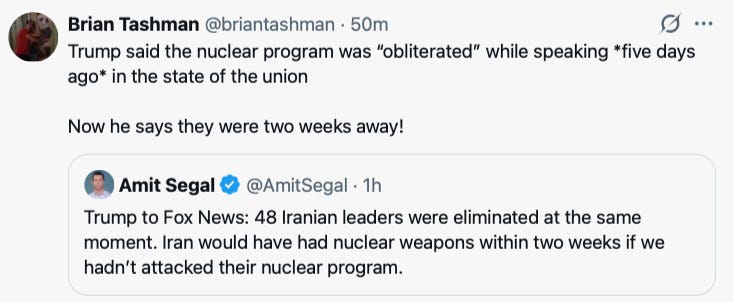
Jeg runder av med to relevante tweeter.